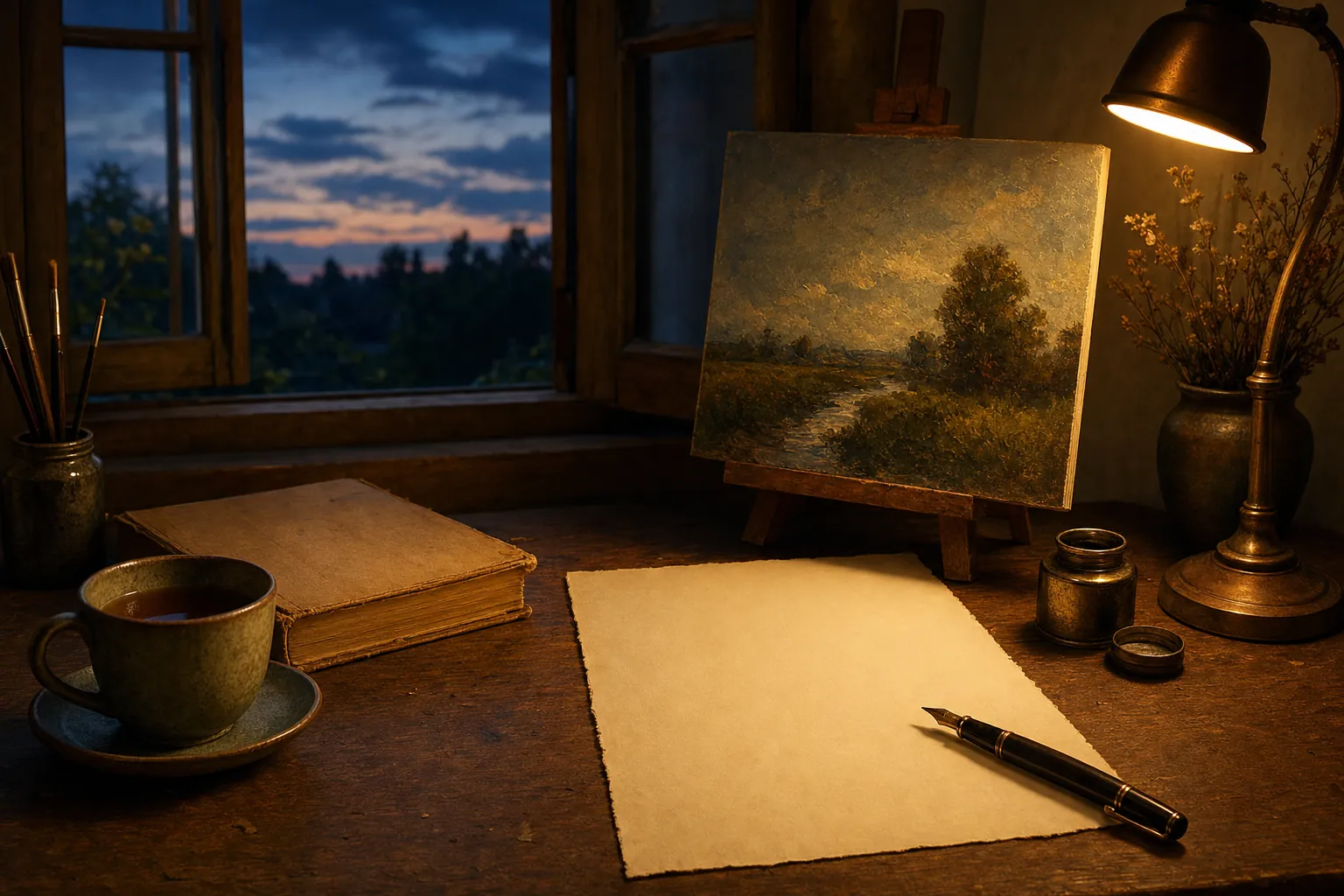
An ode begins with a simple act: choosing something worth looking at longer than usual. It might be a coffee cup with a cracked handle, a pocketknife passed down in a family, a window that catches the late light, or the old tree that has outlasted every change on the block. You do not need a grand subject. An ode makes an ordinary subject feel larger by noticing it clearly.
The word can sound formal, but an ode need not be stiff, rhymed, or addressed to a marble statue. It is a poem of praise, curiosity, and attention. A good ode lets a reader see the subject, then feel why it matters to the speaker. This guide will help you write one in free verse, with room for your own voice.
Start with one real thing
Choose a subject you can describe without looking for very long. Objects work especially well because they carry both physical details and private history. Try a wooden spoon, a pair of boots, a library card, a faded photograph, a garden gate, or a train ticket. A place can work too: a porch in rain, a workbench, the passenger seat of an old car, or a view from a favorite chair.
Before writing the poem, make a quick list. What color is it? What is its texture? What does it sound like? Where has it been? What flaw or small oddity makes it itself? Do not decide what the subject means yet. Let the details arrive first. Specific language gives the poem somewhere solid to stand.
For example, an ode to a mug might begin with the rough place on its rim, the tea stain near the handle, or the way it warms both hands on a cold morning. Praise becomes believable when it is earned through observation. Saying that a mug is precious is less moving than showing the pale ring it leaves on the table every day.
Notice before you praise
An ode is not a greeting card. It does not need to flatter its subject at every turn. In fact, a little honesty makes the affection more convincing. Your old chair may creak. The tree may drop leaves where you wish it would not. A favorite coat may be too thin for winter. Let those imperfections into the poem. They are often where the real relationship lives.
Try writing five plain sentences that begin with “You.” Speak directly to the object or place as though it can hear you. “You keep the scent of rain in your sleeves.” “You lean toward the road.” “You have made the same complaint for forty years.” This is a useful way to find the conversational voice an ode often carries. Later, keep only the lines that feel alive.
The Academy of American Poets’ overview of the ode traces the form from formal public poems to the many personal odes writers create now. That range is good news for a beginner. You can use a traditional shape if you enjoy one, or you can make a modern poem that follows attention wherever it needs to go.
Give the poem a small journey
A list of compliments can become flat, even when every image is lovely. Give the poem a little movement. Begin with what the subject looks or feels like. Then let it bring you to a memory, a question, or a new understanding. The subject does not have to change, but your way of seeing it should.
Imagine an ode to a porch light. The first lines might describe moths circling its yellow glow. The middle might remember someone arriving home late. The ending might widen into the comfort of being expected. The light is still just a light, but it has led the poem from a visible scene toward something more human.
One easy map is three short sections:
- Open with close observation: show us the subject.
- Move toward connection: tell us what it brings to mind, changes, or keeps.
- End with a fresh image or realization: let the subject mean a little more than it did at the start.
You do not need to announce the lesson. Trust the image. If the final line makes you explain what the poem has already shown, cut it and see whether the image can carry the feeling on its own.
Use language that belongs to the subject
The words in an ode should sound as though they grew out of the thing being praised. An ode to a garden may carry dirt, roots, rain, bees, seed packets, and a hose coiled by the fence. An ode to an airplane might use runway light, wing, cloud, engine hum, and distance. You do not need technical vocabulary for its own sake, but a few true words help the poem feel inhabited.
Roy Everett Butler’s work often begins with this kind of close looking. Flight, art, animals, friendship, memory, and the changing light of ordinary rooms all give his poems something visible to hold. Spend a few minutes with the Poem of the Week and notice how an image can open into a larger thought. Then return to a subject from your own life, rather than trying to borrow someone else’s voice.
Verbs are especially useful. Instead of saying the rain is beautiful, let it tap, gather, thread, or darken. Instead of saying the old radio is reliable, let it crackle, wait, carry, or refuse. A strong verb keeps the poem in motion and gives the subject a little presence on the page.
Let the lines breathe
Modern odes often use free verse, which means you do not need a set rhyme scheme or meter. You can let a line end where the image needs a pause. A short line can make a detail stand out. A longer line can carry a thought forward. Read each line aloud, and listen for where your voice naturally wants to rest.
A good first draft can be written as a paragraph. Start there if line breaks make you nervous. Once the words are on the page, look for the phrases you want a reader to pause over. Give those phrases their own lines. The Journal’s free verse guide offers more help with line breaks, sound, and shaping a poem without rules that get in the way.
Try not to make every line the same length. Let the poem’s shape respond to its subject. A poem about a winding path may want a few longer lines. A poem about a small key, a bird, or a candle flame may benefit from short, clear turns. There is no single correct look. What matters is that the page helps the reader hear the poem.
Write a first ode in ten minutes
Set a timer and choose one object within reach. Write without stopping, following this sequence:
- Name three physical details that another person could see.
- Write one small flaw, stain, scratch, or habit the object has.
- Tell where it has been with you.
- Begin a line with “Because of you…” and see what it reveals.
- End on one image you can still see clearly when you close your eyes.
When the timer ends, underline two lines that surprise you. Those may be the beginning and ending of the poem. Everything else can be revised, moved, or left behind. A first draft is a place to find the poem, not a contract to preserve every sentence.
Revise with a light hand
Put the draft aside for a little while, then read it aloud. Listen for a line that sounds like a speech rather than something you would honestly say. Replace general words such as beautiful, special, or amazing with the detail that made you use them. Cut repeated praise. Leave room for the reader to make a connection of their own.
Then ask whether the poem moves. Does it begin close to the subject and arrive somewhere new? If it stays in one place, add a question, a remembered moment, or a contrast. An ode is allowed to be grateful and complicated at the same time. The more particular your attention, the more room there is for feeling.
If you need another starting point, choose one of these poem prompts or try a short exercise from the Journal’s poetry writing exercises. For a more structured form after this free verse practice, the guide to writing a sonnet gives you a useful next challenge.
A few good subjects for your first ode
- The first cup you use each morning.
- A kitchen tool that has outlived several moves.
- A window with a view you know by heart.
- A tree you have watched through more than one season.
- An old map, recipe, photograph, or letter.
- A pair of shoes that remembers a journey.
- A familiar sound at home: a kettle, a radiator, a screen door, or rain on the roof.
Choose the subject that makes you want to add a detail immediately. That small urge is enough. An ode does not require a perfect reason to begin. It asks only that you pay attention long enough for an ordinary thing to show you what it has been holding.
Frequently asked questions
What is an ode in poetry?
An ode is a poem of attention and praise. It may celebrate a person, place, object, or idea, but it becomes interesting when the praise notices something particular rather than simply calling the subject wonderful.
Does an ode have to rhyme?
No. Some traditional odes use formal patterns, while many modern odes use free verse. For a first ode, clear images, an honest voice, and a little movement in the thought matter more than a rhyme scheme.
What should I write an ode about?
Choose something you can see, touch, remember, or describe with real detail. A chipped mug, a favorite tree, a worn jacket, a kitchen chair, or a familiar flight path can all give an ode a strong beginning.
Related posts

How to Write a Sonnet: A Gentle Guide
A clear, patient way to write a fourteen-line sonnet with a focused idea, a turn, and room for your own voice.

Poetry Writing Exercises: 7 Ways to Find a Poem
Seven simple poetry writing exercises to help you find images, memories, sounds, and first lines worth following.

Poem Prompts: 50 Ideas to Start Writing
Fifty gentle poem prompts for finding an image, memory, question, or ordinary moment worth following.